

About SNP
Discover the story of Sibalom Natural Park — from its beginnings as a watershed forest reserve to its establishment as a protected area, and the continuing efforts to preserve its rich forests, biodiversity, and natural heritage for generations to come.
From Ancient Forest
to Protected Reserve
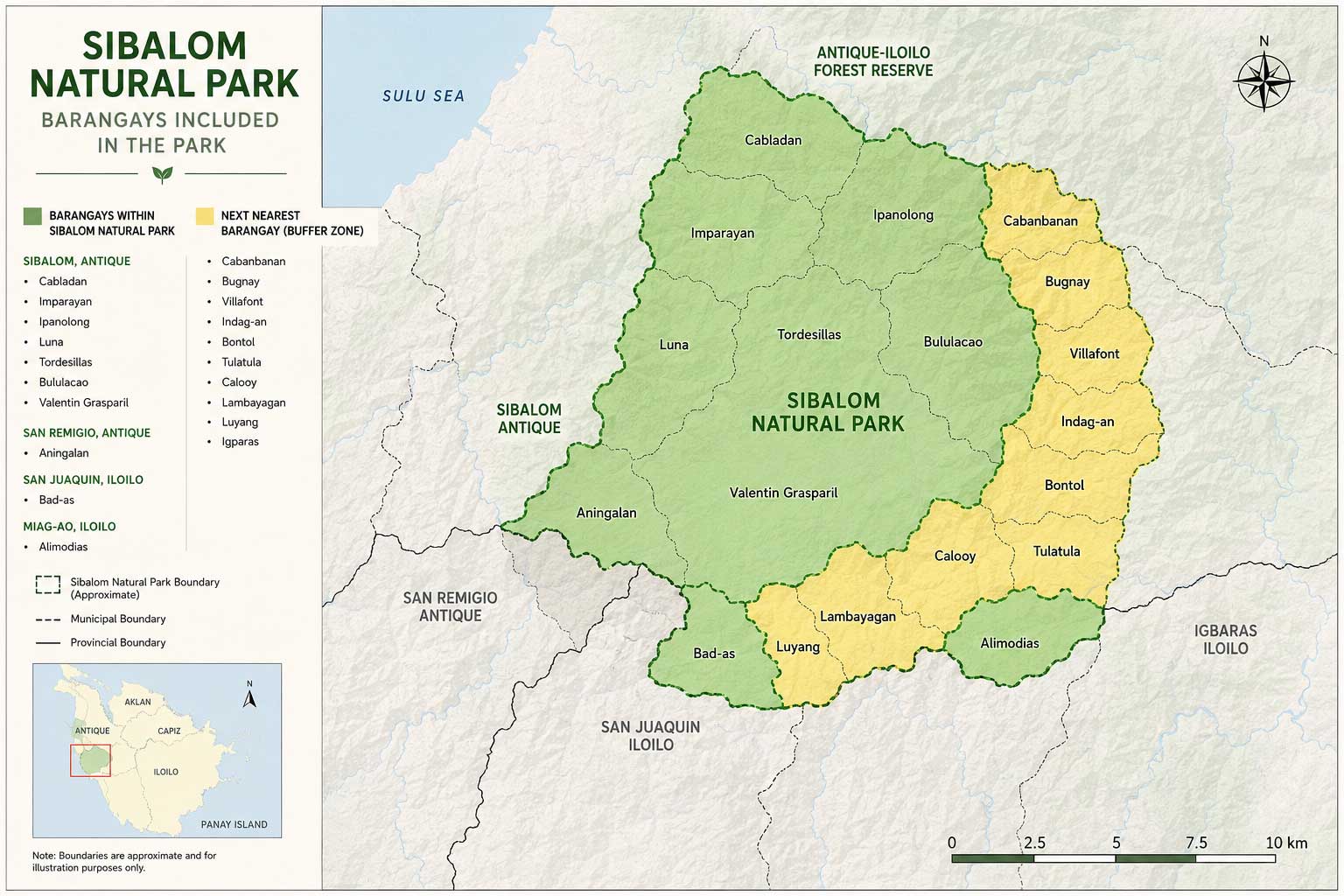
The Sibalom Natural Park has a total land area of 6,778.44 hectares located in the Province of Antique and Iloilo covering the municipality of Sibalom, the larger portion and a small portion in the municipality of San Remigio, San Joaquin and Miagao.
The Sibalom Natural Park is located in the southern part of the Province of Antique in the island of Panay. Lying more or less along geographical coordinates of 122°4’53” to 122°48’43” longitude and 10°42’10” to 10°48’51” latitude. In reference to the Technical Description duly certified accurate by the National Mapping and Resource Information Authority (NAMRIA) attached as Annex as provided under Republic Act No. 11038 or the ENIPAS Act of 2018, this geographic location covers the municipalities of Sibalom, (the larger portion) and part of San Remigio in the province of Antique, part of San Joaquin and Miagao in the province of Iloilo covering a total of twenty (20) barangays to include the next nearest barangay considered as buffer zone.
The SNP perimeter boundary was delineated on the ground with the demarcation of sixty-seven (67) boundary corners on CY 2021. It is bounded on the north by Antique-Iloilo Forest Reserve as described on Bureau of Forestry Map No. F.R. – 96, Presidential Proclamation No. 506 dated January 23, 1940. Bounded on the southern and eastern portion by mountain ridges representing Antique-Iloilo Provincial boundary. On the western side is the classified Alienable and disposable lands all under the municipality of Sibalom, Antique.
Prior to its establishment as a Natural Park by virtue of Republic Act No. 11038 – The Expanded National Integrated Protected Areas System (ENIPAS) Act of 2018 (enacted on June 22, 2018), the area is previously declared as the Tipulu-an Mau-it Watershed Forest Reserve pursuant to Presidential Proclamation No. 605, S. 2000, dated June 28, 1990. By virtue of Presidential Proclamation No. 282, S. 2000 dated April 23, 2000, the Tipulu-an Mau-it Watershed Forest Reserve situated in the Municipality of Sibalom, Province of Antique was declared as a Protected Area pursuant to Republic Act 7586 (NIPAS of 1992) and known as Sibalom Natural Park.
Watershed Forest Reserve
Tipulu-an Mau-it Watershed Forest Reserve was declared through Presidential Proclamation No. 605, providing the initial protected status for the area.
Sibalom Natural Park Established
Through Presidential Proclamation No. 282, the Tipulu-an Mau-it Watershed Forest Reserve was declared a Protected Area under the NIPAS Act of 1992 and became known as Sibalom Natural Park.
ENIPAS Act Recognition
Republic Act No. 11038, or the Expanded National Integrated Protected Areas System (ENIPAS) Act, was enacted on June 22, 2018, providing the current legal framework for Sibalom Natural Park as a protected area.
Boundary Delineation
The perimeter of Sibalom Natural Park was delineated on the ground, with a total of 67 boundary corners established to define its protected area limits.
Protected Area & Buffer Zone
Sibalom Natural Park covers portions of municipalities in Antique and Iloilo, encompassing 20 barangays and including the nearest barangay as a buffer zone.
The Scale of What We Protect
Who Manages the Park
Lead Managing Agency
DENR
Department of Environment and Natural Resources oversees policy and regulatory compliance.Governance Body
Protected Area Management Board
Multi-stakeholder board with LGU, IP, and civil society representation meeting quarterly.Co-stewards
Indigenous Peoples' Organizations
Ati and Kinaray-a communities hold ancestral domain rights and participate in all decisions.On-ground Protection
Park Ranger Corps
38 rangers patrol the park 24/7, conducting wildlife monitoring and enforcement.Community Partners
Member of the PAMB
6 municipalities surrounding the park coordinate buffer zone management and ecotourism.Science & Monitoring